Using Maeumi’s motivational interviewing practice cards
CareOps editorial team · · 3 min read
General information and service guidance published by CareOps. This is not an individual diagnosis or treatment plan.
Translated from our Korean guide. Korean public services, insurance, and helpline numbers refer to South Korea. For urgent help elsewhere, contact local emergency services or a crisis line in your country.
You may want to stop watching YouTube earlier and still value that quiet time at the end of the day. Maeumi’s MI practice offers a place to write down both sides without requiring an immediate decision.
At a glance
- The practice supports your own reflection. It does not let the AI make a decision for you.
- After considering both sides, you can identify helpful conditions, choose an action, or finish by recording your thoughts.
- The Korean screenshot uses the actual practice component with fictional YouTube-related answers. It does not demonstrate clinical effectiveness.
1. Name the behavior you are considering
Start with a specific situation rather than “I need to change my life.” The example says: “I watch YouTube for a long time before bed. I’d like to turn it off a little earlier.” You do not need to have decided to quit. If the exercise follows a conversation, use the relevant part of that conversation and edit it if your view has changed.
Opening a practice does not mean you have agreed to change. The topic should be something you recognize and want to consider. You can keep talking if that is more useful right now.
2. Write down both sides
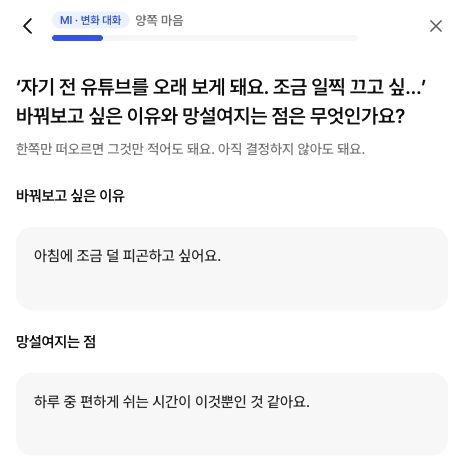
The fictional reason to change is feeling less tired in the morning. The hesitation is that YouTube feels like the only relaxing part of the day. Both can be true.
If only one side comes to mind, you can write that side. The importance rating can be left blank; it is not a diagnostic score or a measure of willpower.
3. Consider what would make trying easier
The next card refers back to the hesitation and asks what would help. You might choose the last video before starting, or decide when to put the phone on its charger without giving up your whole break. If nothing comes to mind, you can continue without inventing an answer.
Importance and confidence are different questions. Something can matter a lot while still being difficult because you are tired or short of time. Focus on useful conditions rather than trying to produce a higher number.
4. Choose an action or keep a reflection
If you want to act, choose an observable step, such as putting the phone on its charger after the last video you selected. It should be your choice and fit your day. If you are not ready, you can choose the path that records your thoughts instead.
Completing Maeumi’s MI practice with an action adds that action to a task card. The reflection-only path does not create a new task. The between-session guide explains how to record what you actually tried.
What this guide covers
This is a CareOps product guide. It does not present the app exercise as equivalent to motivational interviewing with a qualified professional or an individual treatment plan. If sleep or mood difficulties persist and disrupt daily life, seek professional advice. Keep an existing clinician’s plan in view when using an app alongside treatment.
Frequently asked questions
- Do I have to stop watching YouTube entirely?
- No. The example explores a change you are considering. You can choose an action or record your thoughts without committing to quit.
- Must I choose an importance or confidence number?
- The MI cards shown here allow those fields to remain unanswered. A missing answer is different from choosing zero.
Sources
This article provides general information, not diagnosis or treatment. For urgent help, contact local emergency services or a crisis line in your country. In South Korea, the suicide prevention helpline is 109 (24 hours), and the mental health crisis line is 1577-0199.