How to use Maeumi: your first AI counseling session
CareOps editorial team · · 3 min read
General information and service guidance published by CareOps. This is not an individual diagnosis or treatment plan.
Translated from our Korean guide. Korean public services, insurance, and helpline numbers refer to South Korea. For urgent help elsewhere, contact local emergency services or a crisis line in your country.
Before trying an AI counseling app, you may wonder what to say and what happens afterward. In Maeumi, you can start with one situation, check the AI’s understanding, and return to what matters in a later session.
At a glance
- Maeumi is the AI conversation companion in CareOps. The first session is free; continued sessions require checking the available plans.
- You can begin with a recent situation and the kind of help you want. You do not need a diagnosis or a prepared life story.
- The image uses a real app component with fictional content. It is not a customer record, testimonial, or demonstration of treatment outcomes.
1. Start with one situation
Open a conversation with Maeumi and use text or voice to explain what is on your mind. For example: “I could not speak up in a meeting. I keep replaying it now that I’m home.” You do not need to explain everything at once. You can ask for time to think or say that you want to be heard before discussing possible actions.
Describe what you want from the conversation: “Help me understand why I keep coming back to that moment.” Names and contact details of other people are not needed. Keep the information you share limited to what matters for your question.
2. Check the AI’s understanding
Treat an interpretation as something to check. If Maeumi says you felt disliked but you were worried about seeming unprepared, correct that distinction. Ask it to separate things you reported from things it inferred. An AI response can sound confident while missing important context.
A structured exercise may be suggested during the conversation. You can say you would rather continue talking. The purpose of a card is to help you organize your own experience, not to test whether you know a correct answer.
3. Review what you discussed
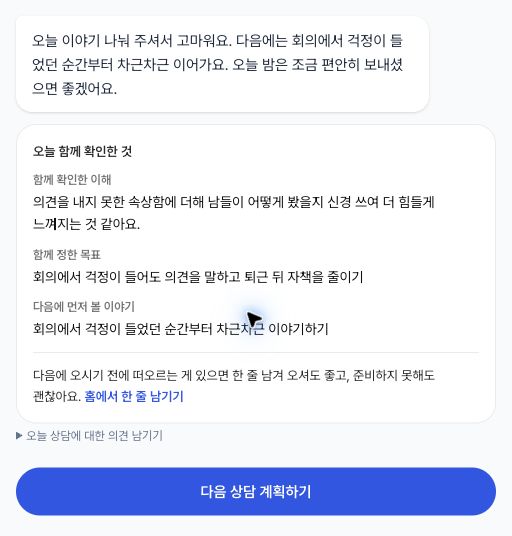
The example separates the disappointment of not speaking up from worry about how other people saw the situation. It also identifies something to revisit. A recap is not a complete transcript. If it misses your meaning, explain the correction and repeat any important context in your next conversation.
You do not have to leave every session with an assignment. Sometimes talking is enough. If you decide to leave a note before returning, write what actually occurred. You can return even if you have nothing prepared.
4. Continue from what happened in daily life
Next time you might say: “I wrote down a question before the meeting, but I still could not ask it.” Both what you tried and what got in the way are useful topics. See the between-session practice guide for how records can support this conversation.
Cost and scope
Your first session is free. Check the current plans and purchase screen for continued use. The separate counselor plan has its own role and cost. Maeumi is AI and does not provide diagnosis, prescriptions, or emergency response. Read the privacy policy for storage, processing, and deletion details.
Frequently asked questions
- Will the app repeat this exact conversation?
- No. The guide and image use fictional examples to show the flow. Actual responses depend on the conversation and may contain mistakes.
- Do I need to prepare a long explanation?
- No. A recent situation and the kind of help you want are enough to begin. You can add context gradually.
Sources
This article provides general information, not diagnosis or treatment. For urgent help, contact local emergency services or a crisis line in your country. In South Korea, the suicide prevention helpline is 109 (24 hours), and the mental health crisis line is 1577-0199.